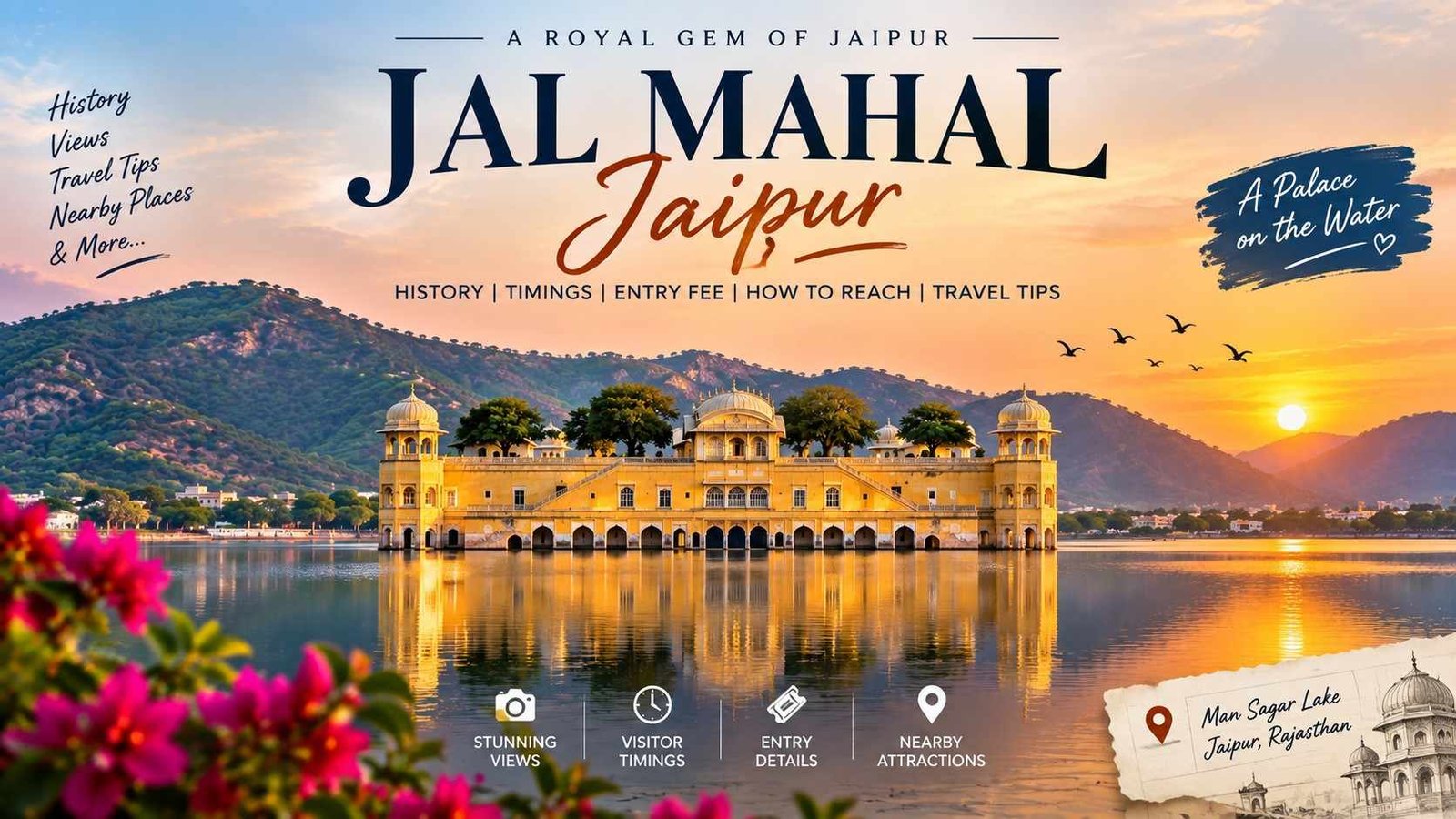
Jal Mahal Jaipur is one of those places you can see in a few minutes and still remember long after you’ve left.
The palace sits in the middle of Man Sagar Lake on Amer Road, with the Aravalli hills behind it. From the lakeside, only the upper part of the building is visible, giving Jal Mahal its famous appearance of rising from the water.
You don’t need half a day here. For most visitors, 30 to 45 minutes is enough for the view, photographs and a short walk around the lakefront.
There’s one practical detail to know before you go: regular tourists can’t enter the palace itself. Jal Mahal is viewed from the accessible lakeside area.
If you’re planning your first trip to the city, it’s worth looking at a broader Jaipur travel guide before deciding how to fit Jal Mahal into your itinerary.
Table of Contents
Jal Mahal Jaipur Quick Facts
| Attraction | Approximate distance from Jal Mahal |
|---|---|
| Amer Fort | About 7 to 8 km |
| Kanak Vrindavan | About 1 km |
| Gaitore | About 3 to 4 km |
| Nahargarh Fort | About 6 to 8 km |
| Hawa Mahal | About 5 to 6 km |
| City Palace | About 5 to 6 km |
| Jantar Mantar | About 5 to 6 km |
| Jaipur Railway Station | About 10 to 11 km |
Rajasthan Tourism lists Jal Mahal as a sightseeing attraction viewed from the banks of Man Sagar Lake, while Incredible India lists visiting hours of 6:00 AM to 6:00 PM.
Where Is Jal Mahal Jaipur?
Jal Mahal is located in Man Sagar Lake on Amer Road, north of Jaipur’s historic centre.
It’s on the route between Jaipur and Amer Fort, which makes it easy to include in a day of sightseeing.
If you’re visiting Jaipur for the first time, we usually recommend treating Jal Mahal as a short stop before continuing towards the forts around Amer.
You can combine it with Amer Fort, Jaigarh Fort, Nahargarh Fort or Kanak Vrindavan without creating a separate trip across the city.
If you’re still deciding what else to see, our guide to the top places to visit in Jaipur can help you build the rest of your sightseeing route.
Why Is Jal Mahal Called the Water Palace?
The name comes from two simple Hindi words.
Jal means water and Mahal means palace.
Jal Mahal sits in the middle of Man Sagar Lake, so from the shore it appears to rise directly from the water.
The palace isn’t actually floating.
It has 5 storeys, with the lower levels submerged when the lake is full. Only the upper storey remains visible above the water, which creates the effect seen in most photographs of Jal Mahal.
The lake level also affects how much of the structure you can see, so photographs taken in different seasons can look surprisingly different.
Jal Mahal Jaipur History
The history of Jal Mahal has some disagreement around its exact construction date and original patron.
Rajasthan Tourism attributes the hunting-lodge origin of Jal Mahal to Maharaja Madho Singh I, who is said to have used it during duck-hunting trips.
Another heritage record from the Indira Gandhi National Centre for the Arts attributes the palace to Sawai Pratap Singh and gives 1799 as its construction date.
You’ll therefore see different versions mentioning 1750, 1799, Madho Singh I and Sawai Pratap Singh.
For a travel guide, the safest approach is to acknowledge that difference rather than present one disputed date as settled fact.
The palace was associated with royal leisure and hunting, which fits its unusual position in the middle of the lake.
Was Jal Mahal Built as a Residence?
The original purpose is generally connected with royal recreation and hunting rather than being a main royal residence.
Rajasthan Tourism describes it as a hunting lodge used during duck-hunting trips.
Its location makes sense in that context. The building sits away from the shore, surrounded by water and backed by the hills.
Jal Mahal Architecture
Jal Mahal has a Rajput architectural character, with Mughal influences visible in parts of its design.
The palace was built from sandstone and has a symmetrical layout.
Look closely at the visible upper level and you’ll see the chhatris, roofline and other decorative details that give the building its distinctive appearance.
The most unusual part of the architecture is actually underwater.
When Man Sagar Lake is full, 4 of the palace’s 5 levels remain submerged. The construction and lime mortar were designed to withstand the surrounding water.
From the public viewing area, you’re mainly seeing the upper level.
That’s what creates the famous Jal Mahal view.
What Can You See From the Lakeside?
From the accessible side of Man Sagar Lake, you can see:
- The upper level of Jal Mahal
- The palace’s chhatris
- Man Sagar Lake
- The Aravalli hills
- Birds around the lake
- Reflections across the water
Take a phone with a decent zoom if photography matters to you. Jal Mahal sits far enough from the shore that a standard wide-angle photograph can make the palace look smaller than it appears in person.
Jal Mahal Jaipur Timings
Jal Mahal Jaipur timings are commonly listed as 6:00 AM to 6:00 PM.
The published timings are:
Opening: 6:00 AM
Closing: 6:00 PM
These timings should be understood as the accessible sightseeing period around the attraction.
They don’t mean the palace interior is open for ordinary tourists.
If you’re planning a sunrise visit, arrive early enough to find your viewing position before the light changes.
Jal Mahal Jaipur Entry Fee
For ordinary sightseeing, there is no regular palace admission ticket because tourists don’t have normal access to the palace interior.
The attraction is generally viewed from the lakeside.
This is worth knowing because you’ll find older travel pages and local sellers making different claims about Jal Mahal entry.
If someone offers you a ticket claiming that it gives you routine access inside the palace, check the current official position before paying.
Can You Go Inside Jal Mahal Jaipur?
Regular tourists can’t currently enter Jal Mahal as a normal sightseeing attraction.
Your visit is mainly about seeing the palace from the lakefront, taking photographs and enjoying the setting around Man Sagar Lake.
That also changes how you should plan your time.
You don’t need 2 or 3 hours here. 30 to 45 minutes is enough for most visitors.
If you’re travelling with children or older family members, Jal Mahal is also an easy stop because there’s considerably less walking than at Jaipur’s major forts.
Best Time to Visit Jal Mahal Jaipur
The best time depends on what you want to photograph and how you’re planning the rest of your Jaipur day.
Early Morning
Early morning gives you softer light and a quieter atmosphere around the lake.
It’s also convenient if you’re planning to continue towards Amer Fort.
You can see Jal Mahal first, then head towards the fort before the day gets too busy.
Late Afternoon
The hour before sunset is another good time for photographs.
The light becomes softer and the sandstone takes on warmer tones.
Give yourself enough time to reach the viewpoint before sunset rather than arriving at the exact moment the sun is disappearing.
Monsoon
Monsoon can bring greener hills around Man Sagar Lake.
Cloudy skies can also make photographs look softer than they do under the harsh summer sun.
Rain is the main inconvenience. Keep your phone and camera protected if the forecast looks unsettled.
Winter
October to March is generally a comfortable period for sightseeing in Jaipur.
Mornings can be cool, while afternoons are usually easier for walking around outdoor attractions.
If you’re planning a wider Rajasthan trip, our best time to visit Rajasthan guide can help you choose the right month for the rest of your itinerary.
Jal Mahal Photography Tips
Jal Mahal is one of those places where timing matters more than expensive equipment.
Try these simple tips:
- Visit around sunrise or before sunset.
- Use moderate optical zoom instead of pushing digital zoom too far.
- Leave some space around the palace so the lake and hills become part of the photograph.
- Look for reflections after rain.
- Take both horizontal and vertical photographs.
- Keep your camera or phone steady during low-light shots.
- Stay in the public viewing area while photographing.
For phone photography, clean the camera lens before you start.
It sounds minor, but fingerprints become very obvious when you’re photographing bright skies and reflections on water.
Things to Do at Jal Mahal Jaipur
Jal Mahal isn’t a place where you need a long list of activities.
The main attraction is the setting.
1. Photograph Jal Mahal
Photography is the main reason most visitors stop here.
The palace, lake and Aravalli hills give you several different compositions depending on where you’re standing and how much of the surrounding landscape you include.
2. Spend Time Beside Man Sagar Lake
Don’t photograph the palace and immediately leave.
Spend a few minutes looking across the lake and watching the changing light.
The lakefront gives you a different side of Jaipur from the busy streets and crowded monuments.
3. Watch the Birds
Man Sagar Lake has an important bird population.
Restoration work has helped improve the lake’s ecological condition, and recent reporting has recorded around 170 bird species around the lake.
If you’re interested in birds, bring binoculars and give yourself a little extra time.
4. Visit Around Sunset
Sunset is a good time to slow down here.
Once you’ve taken your photographs, stay for a few minutes and watch the light change across the lake before continuing into Jaipur.
Man Sagar Lake and the Restoration Story
Jal Mahal’s story isn’t only about the palace.
For years, Man Sagar Lake suffered from pollution and sewage inflow, which affected the water and surrounding ecosystem.
Restoration work included sewage treatment, desilting, habitat creation and other measures aimed at improving the lake.
The lake’s recovery has also helped birdlife return to the area.
So when you visit Jal Mahal, you’re looking at a historic palace and a lake that has gone through a long environmental recovery.
How to Reach Jal Mahal Jaipur
Jal Mahal is on Amer Road, so it’s relatively easy to reach from central Jaipur.
By Car or Taxi
A private car or taxi is the easiest option if you’re visiting several attractions in one day.
You can stop at Jal Mahal on the way to Amer Fort and then continue towards Jaigarh or Nahargarh.
This saves you from crossing the city repeatedly.
By Auto-Rickshaw
Auto-rickshaws are available from central Jaipur.
If you’re not using an app-based service or meter, agree on the fare before starting.
By Bus
Local buses also operate along the Jaipur-Amer route.
For families, international visitors and anyone planning several attractions in one day, a private vehicle is generally more convenient.
How Far Is Jal Mahal From Jaipur Attractions?
Distances vary depending on your exact starting point and traffic, so use these figures for rough itinerary planning.
| Attraction | Approximate distance from Jal Mahal |
|---|---|
| Amer Fort | About 7 to 8 km |
| Kanak Vrindavan | About 1 km |
| Gaitore | About 3 to 4 km |
| Nahargarh Fort | About 6 to 8 km |
| Hawa Mahal | About 5 to 6 km |
| City Palace | About 5 to 6 km |
| Jantar Mantar | About 5 to 6 km |
| Jaipur Railway Station | About 10 to 11 km |
Traffic can make a bigger difference than the distance itself.
That’s why we recommend planning your Jaipur itinerary by area and route, rather than simply choosing attractions based on the number of kilometres between them.
Places to Visit Near Jal Mahal Jaipur
Jal Mahal fits naturally into the northern Jaipur sightseeing route.
Amer Fort
Amer Fort is the obvious attraction to combine with Jal Mahal.
The fort has courtyards, palaces, gates, gardens and the famous Sheesh Mahal.
You can visit Jal Mahal early in the morning and continue to Amer Fort without making a major detour.
Before you go, our Amer Fort 2026 Jaipur guide covers the fort’s history and practical visitor information.
Jaigarh Fort
Jaigarh Fort sits above the Amer area.
Its huge fort walls and military architecture make it a good follow-up if you enjoy Jaipur’s defensive history.
You can combine it with Amer Fort before returning towards the city.
Nahargarh Fort
Nahargarh sits in the Aravalli hills above Jaipur.
The main reason many visitors include it is the view over the city.
If you’re staying in Jaipur for more than 1 day, you can give Nahargarh a separate time slot rather than rushing through it.
Gaitore
Gaitore is a quieter stop near the Jaipur-Amer road.
The site is known for the marble and sandstone cenotaphs of Jaipur’s former rulers and their carved chhatris.
It’s a useful addition if you want somewhere calmer between the larger attractions.
Kanak Vrindavan
Kanak Vrindavan is close to Jal Mahal and fits easily into the same route.
It’s a good short stop if you’re travelling along Amer Road and want to break up the larger fort visits.
Hawa Mahal
After completing the Amer Road section of your day, head towards Jaipur’s old city.
Hawa Mahal can then be combined with nearby markets and historic streets.
The timing works well because you can spend the morning around Jal Mahal and Amer before moving into the old city later in the day.
City Palace and Jantar Mantar
City Palace and Jantar Mantar are both in the old city.
They can be paired with Hawa Mahal without adding unnecessary driving.
If you’re building a complete Jaipur sightseeing route, our Jaipur attractions guide can help you decide which attractions deserve more time.
A Practical 1-Day Jaipur Itinerary Including Jal Mahal
If you only have 1 day in Jaipur, this is one practical way to arrange it:
7:00 AM: Start in Jaipur
7:30 AM: Jal Mahal viewpoint
8:15 AM: Continue to Amer Fort
11:00 AM: Jaigarh Fort or lunch
1:30 PM: Return towards the old city
2:00 PM: City Palace
3:30 PM: Jantar Mantar
4:30 PM: Hawa Mahal and nearby market
6:00 PM onward: Dinner and shopping
The exact timing depends on traffic and how long you spend at each attraction.
Don’t try to force every Jaipur monument into one day.
If you’d prefer a ready-made itinerary rather than planning everything yourself, you can also look at Taj Explorer’s Overnight Jaipur Tour, which is a natural option for travellers who want more time to experience Jaipur.
Jal Mahal and the Jaipur Sightseeing Circuit
A simple route can look like:
Jal Mahal → Amer Fort → Jaigarh Fort → Nahargarh Fort → City Palace → Jantar Mantar → Hawa Mahal
You don’t have to visit every attraction.
If forts are your priority, spend more time around Amer, Jaigarh and Nahargarh.
If food, markets and old-city architecture matter more to you, leave more time for Hawa Mahal, City Palace and the streets around them.
Our guide to Jaipur’s top attractions can help you adjust the route according to how many days you have.
Is Jal Mahal Worth Visiting?
Yes, especially if you’re already travelling along Amer Road.
Jal Mahal is a short sightseeing stop.
You won’t walk through royal rooms or spend hours inside the palace. The visit is about the view across Man Sagar Lake, the architecture, the hills and photography.
For most travellers, that’s enough.
If you’re heading to Amer Fort anyway, stopping at Jal Mahal adds very little travel time.
Is Jal Mahal Jaipur Open at Night?
The palace isn’t a regular night-entry attraction.
The commonly published visitor timing is 6:00 AM to 6:00 PM.
You may find photographs showing Jal Mahal after dark, sometimes illuminated, but that doesn’t mean the palace is open for ordinary night visits.
For photography, plan around daylight and sunset.
Can You Take a Boat to Jal Mahal?
Don’t plan your visit around a public tourist boat ride to the palace.
Jal Mahal isn’t routinely open to general visitors, so the normal sightseeing experience is from the lakeside.
If someone offers an unofficial boat ride or claims to sell palace-access tickets, verify the current rules before paying.
Is Jal Mahal Good for Families?
Yes.
There’s relatively little walking compared with attractions such as Amer Fort or Nahargarh Fort.
That makes Jal Mahal an easy short stop for families travelling with children or older relatives.
The main thing to watch is traffic around Amer Road. Keep children close while moving around the public viewing area.
Is Jal Mahal Good for Photography?
Yes.
Early morning and the period before sunset are particularly useful for photography.
A longer lens helps because the palace sits in the lake rather than directly beside the viewing area.
For phone photography, use moderate zoom and keep the lens clean.
If you want a wider photograph, include the Aravalli hills and lake rather than filling the entire frame with the palace.
What Should You Wear to Jal Mahal?
Jal Mahal is an outdoor stop, so dress for Jaipur’s weather.
Summer
- Light cotton clothing
- Sunglasses
- Hat or cap
- Water
Winter
- Light jacket for early mornings
- Comfortable walking shoes
Monsoon
- Light rain protection
- Waterproof phone pouch
- Shoes suitable for wet surfaces
If you’re visiting Amer Fort and other monuments on the same day, comfortable footwear matters more than dressing specifically for Jal Mahal.
Where to Eat After Visiting Jal Mahal
Jal Mahal itself isn’t where we’d plan a major meal.
You’re better off continuing towards Jaipur and choosing a restaurant that fits your route.
If you’re heading towards the old city, you can combine the sightseeing day with traditional Jaipur food.
For restaurant ideas, see our guide to the best restaurants in Jaipur and choose somewhere close to the part of the city you’ll be visiting next.
Common Mistakes to Avoid at Jal Mahal
Expecting Palace Entry
This is the biggest mistake.
You can see Jal Mahal from the lakeside, but ordinary tourists don’t have normal interior access.
Spending Half a Day Here
You probably don’t need to.
For most visitors, 30 to 45 minutes is enough.
Visiting Only at Midday
Strong overhead sunlight can make photographs look flat.
Morning and late afternoon usually give you better light.
Believing Every Entry-Fee Claim Online
Information about Jal Mahal varies across travel websites.
Before paying for anything advertised as palace entry or boating, check the current official information.
Crossing Restricted Areas
Stay within public viewing areas and follow local instructions.
Jal Mahal Jaipur FAQs
What Is Jal Mahal Jaipur Famous For?
Jal Mahal is famous for its position in the middle of Man Sagar Lake and the way the building appears to rise from the water.
When the lake is full, only the upper level is visible.
What Is the Entry Fee for Jal Mahal Jaipur?
There is no regular palace admission for ordinary tourists because the palace isn’t open for routine public entry.
Visitors generally view Jal Mahal from the lakeside.
What Are Jal Mahal Jaipur Timings?
The commonly published timing is 6:00 AM to 6:00 PM.
Where Is Jal Mahal Located?
Jal Mahal is located in Man Sagar Lake on Amer Road, Jaipur, Rajasthan.
Can Tourists Go Inside Jal Mahal?
No. General tourists currently can’t enter the palace as a normal sightseeing attraction.
How Much Time Do I Need at Jal Mahal?
Plan around 30 to 45 minutes for the viewpoint, photographs and a short walk.
What Is the Best Time to Visit Jal Mahal?
Early morning and the hour before sunset are good choices for photography.
October to March is generally a comfortable period for outdoor sightseeing in Jaipur.
Who Built Jal Mahal Jaipur?
Published historical records don’t completely agree.
Rajasthan Tourism attributes the hunting-lodge origin to Maharaja Madho Singh I, while an IGNCA heritage record attributes the 1799 construction to Sawai Pratap Singh.
Why Does Jal Mahal Look Like It Is Floating?
The palace has 5 levels, with the lower 4 submerged when the lake is full.
Only the upper level remains visible above the water.
Is Jal Mahal Inside Jaipur City?
Yes.
It’s located on Amer Road and sits on the route connecting central Jaipur with Amer Fort.
Can I Visit Jal Mahal and Amer Fort on the Same Day?
Yes.
They fit naturally into the same sightseeing route because both are on the Amer Road side of Jaipur.
Is Jal Mahal Worth Visiting?
Yes, especially if you’re already visiting Amer Fort or travelling along Amer Road.
Give it a short stop rather than planning a long visit.
Final Tips for Visiting Jal Mahal Jaipur
If you’re visiting Jaipur for the first time, keep Jal Mahal simple.
Arrive early or before sunset. Spend 30 to 45 minutes by the lake. Take your photographs, look across Man Sagar Lake and then continue towards the next attraction.
The easiest way to make the visit worthwhile is to combine Jal Mahal with Amer Fort and the other attractions along the Amer Road route.
If you’re staying longer, spread the forts, old city sights, food stops and markets across your Jaipur itinerary instead of trying to see everything in one day.
For a wider Jaipur plan, start with the Jaipur travel guide, then use the individual attraction guides to build the route around the places you actually want to see.