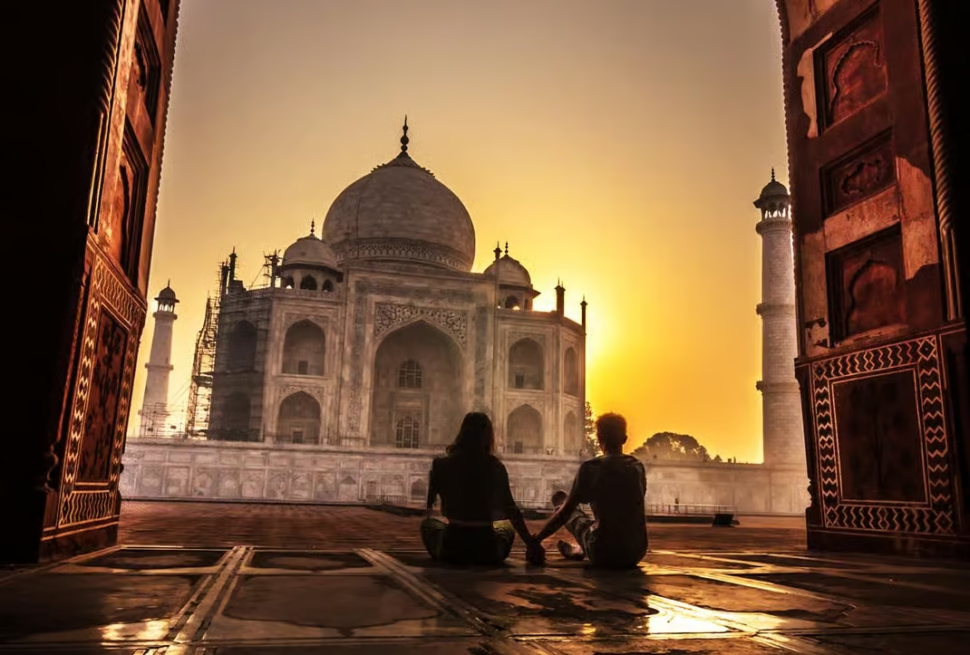

The Taj Mahal Urs is one of the most unusual times to visit the Taj Mahal in Agra. For a few days each year, visitors can enter the monument under special arrangements connected with the death anniversary of Mughal emperor Shah Jahan.
The biggest attraction for travellers is simple: the Taj Mahal can have free entry during the Urs, and the underground graves of Shah Jahan and Mumtaz Mahal become accessible to visitors.
But there are special timings, security restrictions and religious ceremonies that you should understand before planning your visit.
Here’s what you need to know about the Taj Mahal Urs, including the free-entry day, expected dates, timings, Shah Jahan’s tomb, what happens inside and how to plan your Agra trip.
Table of Contents
What is the Taj Mahal Urs?
The Taj Mahal Urs is the annual commemoration of the death anniversary of Shah Jahan, the Mughal emperor who commissioned the Taj Mahal for his wife Mumtaz Mahal.
The word Urs is commonly used for the death anniversary of a Muslim saint or revered person. At the Taj Mahal, the occasion has a religious as well as historical significance.
During the Urs, special ceremonies are held at the Taj Mahal, including prayers and traditional rituals.
One of the most interesting things for visitors is that the actual graves of Shah Jahan and Mumtaz Mahal, located in the lower chamber beneath the main cenotaphs, are opened to visitors during this period.
For most of the year, visitors see the beautifully decorated cenotaphs inside the main mausoleum. During the Urs, you get a rare opportunity to see the actual burial chamber.
Is the Taj Mahal free during Urs?
Yes, special free-entry arrangements are made during the Taj Mahal Urs.
However, free entry doesn’t necessarily mean that the monument is free throughout all three days.
The opening arrangements can vary by year. For the 2026 Urs, which marked Shah Jahan’s 371st Urs, the reported arrangement was:
| Date | Entry arrangement |
|---|---|
| January 15, 2026 | Free entry from 2 PM until sunset |
| January 16, 2026 | Free entry from 2 PM until sunset |
| January 17, 2026 | Free entry throughout the day under special Urs arrangements |

The exact schedule for future Urs celebrations should always be checked with the Archaeological Survey of India and local authorities before travelling.
If you’re visiting the Taj Mahal at another time of year, you’ll need a normal ticket. Our guide to the Taj Mahal entry fee and ticket information explains the regular ticket arrangements and what different tickets cover.
What is the Taj Mahal ticket free day?
The phrase “Taj Mahal ticket free day” usually refers to the special entry arrangements during the final day of the Shah Jahan Urs.
This is different from the normal Taj Mahal weekly closure and normal ticketing system.
The free-entry period is connected specifically with the Urs celebrations. Because the dates follow the Islamic lunar calendar, the Urs moves earlier each year in the Gregorian calendar.
So if you’re searching for the Taj Mahal free entry day, don’t rely on an old date from a previous year. Check the current year’s official announcement before making travel arrangements.
Taj Mahal Urs dates 2027
The Urs follows the Islamic calendar, so its Gregorian dates change every year.
The 2026 Urs was held from January 15 to January 17, 2026.
For 2027, the expected period falls earlier in January, but travellers should wait for the official announcement confirming the exact dates and entry timings.
This matters because the free-entry arrangements, opening hours and access to the underground graves are special arrangements and can change.
If you’re planning your entire Agra visit around the Urs, it’s better to confirm the dates before booking trains, hotels or flights.
Why is the Taj Mahal Urs special?
There are three main reasons the Urs attracts visitors.
1. Free entry during special hours
The possibility of visiting the Taj Mahal without the normal entry ticket makes the Urs particularly interesting for budget-conscious travellers.
Keep in mind that free entry can also mean larger crowds, especially when visitors know that tickets aren’t required.
2. Access to the real graves
The main cenotaphs inside the Taj Mahal are not the actual graves.
The real graves of Shah Jahan and Mumtaz Mahal are located in the lower chamber beneath them.
During the Urs, visitors can descend into this area and see the actual burial site.
It’s a very different experience from the regular Taj Mahal visit, and you should expect the atmosphere to be more religious than during a normal sightseeing day.
3. Religious ceremonies and cultural traditions
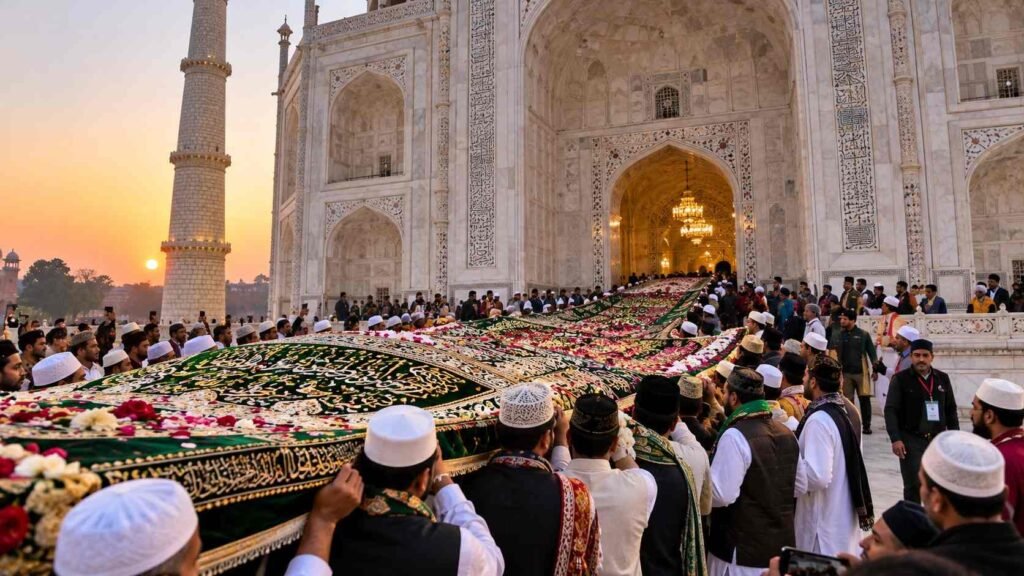
The Urs includes traditional ceremonies and gatherings.
Depending on the programme for the year, these can include:
- Ghusl
- Sandal ceremony
- Chadar Poshi
- Quran Khani
- Qawwali
- Mushaira
- Special prayers
One particularly striking tradition is the offering of a large chadar at the tomb.
During the 2026 Urs, reports mentioned a chadar measuring around 1,720 metres.
Can tourists visit the real tombs of Shah Jahan and Mumtaz Mahal?
Yes.
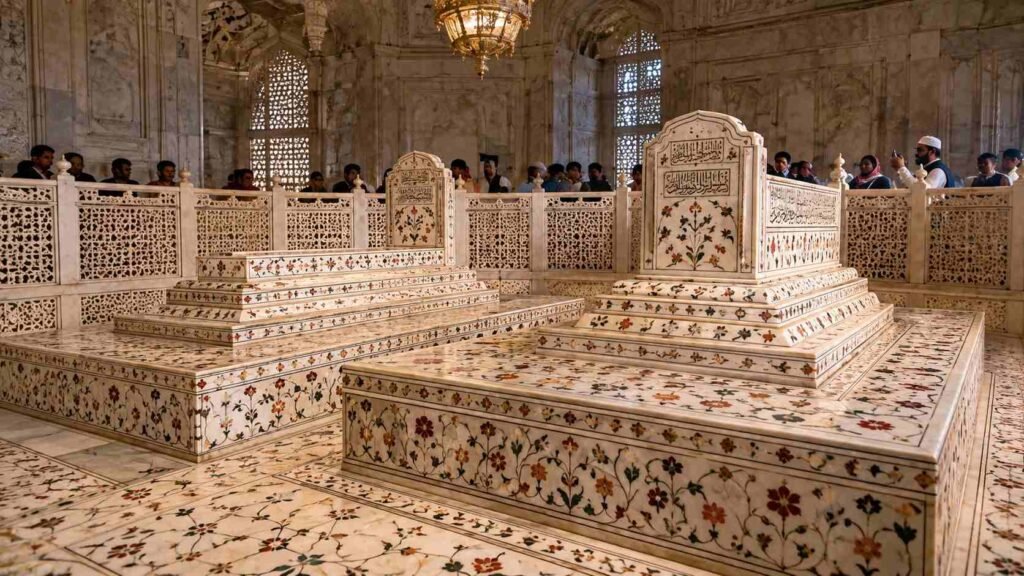
During the Urs, the underground chamber containing the actual graves is opened to visitors.
This is one of the main reasons history enthusiasts choose to visit Agra during the event.
Shah Jahan was buried beside Mumtaz Mahal after his death in 1666. His placement beside Mumtaz is also why the symmetry of the main cenotaph chamber is different from the original arrangement planned for Mumtaz alone.
If you’re interested in the history behind the monument, it’s worth reading a broader guide to discovering the Taj Mahal in Agra before your visit.
Who can visit the Taj Mahal during Urs?
The Taj Mahal is a major tourist attraction and the Urs also attracts people interested in Mughal history and culture.
Visitors from different backgrounds can attend subject to the rules and security arrangements in place during the event.
The important thing is to behave respectfully.
The Urs is a religious occasion, so visitors should avoid treating ceremonies as entertainment. Follow instructions from security personnel and local authorities, especially around prayer areas and the tomb chamber.
What happens during the three days?
The exact programme can change, but the Urs traditionally follows a three-day sequence of religious activities.
Day 1
The first day generally includes the opening of the special Urs arrangements and religious rituals.
Entry may begin later in the afternoon rather than at the normal opening time.
Day 2
The second day continues with prayers and other religious activities.
This can be one of the busier periods, especially during the afternoon and evening.
Day 3
The final day is usually the most significant for visitors because special free-entry arrangements can extend through the day.
The actual graves are also accessible during the Urs period.
If your main reason for visiting is the underground burial chamber, plan your trip around the officially announced access timings rather than assuming that the chamber will remain open throughout normal Taj Mahal hours.
Is the Taj Mahal open on Friday during Urs?
Normally, the Taj Mahal is closed to general visitors every Friday because of Friday prayers at the mosque inside the complex.
The Urs can create a special exception.
For example, during the 2026 Urs, January 17 fell on a Saturday, so the special Urs schedule did not require the same Friday adjustment. In other years, however, the Urs dates can overlap with Friday.
Don’t assume that the usual Friday closure automatically applies or automatically doesn’t apply.
Check the official announcement for that year’s Urs before travelling.
For ordinary visits, our detailed guide to Taj Mahal visiting timings and opening hours is useful for understanding the normal schedule.
What time should you reach the Taj Mahal during Urs?
If you’re visiting during the free-entry period, arriving early is usually the safer choice.
Crowds can increase quickly when visitors know they don’t need to purchase a normal entry ticket.
For afternoon entry days, don’t arrive at the last minute. Security checks, queues and movement around the complex can take time.
For the full-day special entry period, early morning is usually more comfortable than arriving around midday.
If you want to understand how a normal early-morning Taj Mahal visit works, you can also look at the Taj Mahal Sunrise Tour.
What should you wear to the Taj Mahal Urs?
Dress comfortably and respectfully.
You’ll be walking, standing in queues and potentially spending several hours around the monument.
For the Urs, modest clothing is the better choice because you’re attending a religious occasion.
Comfortable footwear is also useful because the Taj Mahal complex involves walking and security procedures.
Our guide on what to wear at the Taj Mahal covers practical clothing advice for different seasons.
Can you take photographs during the Urs?
Photography is allowed in many areas of the Taj Mahal complex, but the religious ceremonies and burial chamber require greater sensitivity.
Don’t push into a crowd for a photograph.
Don’t photograph people who are praying without permission.
And follow any temporary restrictions imposed by security personnel.
During the Urs, your priority should be experiencing the site respectfully rather than trying to photograph every ceremony.
What items are restricted during the Urs?
Security can be stricter during the Urs because of the larger crowds and religious gathering.
Visitors should avoid carrying unnecessary items.
Restrictions can include religious flags, banners, posters and tobacco products, depending on the year’s security arrangements.
Always follow the instructions at the entrance because temporary restrictions can be introduced.
How to plan a Taj Mahal Urs trip from Delhi
If you’re staying in Delhi, Agra is practical as a day trip.
You can travel by road or train, depending on your schedule.
A private car gives you more control over your arrival time, especially if you want to reach Agra before a particular Urs ceremony.
Our one-day trip to Agra from Delhi guide explains how to structure a full day around the Taj Mahal and other Agra sights.
For travellers who prefer the train, the same-day Agra Taj Mahal tour by Gatimaan Express is another practical option.
And if you prefer travelling by road, our same-day Agra tour by car gives you more flexibility with timings. If you prefer a more premium experience from Delhi, you can also consider our Taj Mahal luxury car tour from Delhi by Mercedes or BMW, especially if comfort and a private chauffeur-driven journey are priorities.
A practical one-day Urs itinerary
If you’re travelling from Delhi, here’s how we would structure the day when the Urs schedule allows an afternoon Taj Mahal entry:
Morning
Leave Delhi early.
Arrive in Agra and have breakfast or an early lunch.
Visit Agra Fort before heading to the Taj Mahal.
You can read our Agra Fort history, travel tips and tour guide before your trip so you know what you’re looking at once you arrive.
Afternoon
Head towards the Taj Mahal.
Allow extra time for security and queues.
Enter during the officially announced Urs hours.
Late afternoon and evening
Explore the Taj Mahal complex and, where permitted, visit the underground burial chamber.
Spend some time observing the religious ceremonies respectfully.
Then return to Delhi.
If you’d rather have a slower day, staying overnight in Agra is a better option.
Should you visit Agra during the Taj Mahal Urs?
If you’re interested in Mughal history, Islamic traditions or the lesser-seen side of the Taj Mahal, yes, the Urs is a fascinating time to visit.
But it isn’t the best choice if your only goal is a quiet Taj Mahal experience.
The free-entry arrangements can attract significant crowds, and the atmosphere is very different from a regular sightseeing visit.
For first-time visitors who want to understand the monument without the Urs crowds, a normal sunrise visit may be more comfortable.
If you’re deciding between morning and evening, our Taj Mahal sunset tour is another option to consider.
Taj Mahal Urs vs normal Taj Mahal visit
| Feature | Taj Mahal Urs | Normal visit |
|---|---|---|
| Entry fee | Special free-entry arrangements | Normal ticket required |
| Actual graves | Accessible during Urs | Normally not accessible |
| Religious ceremonies | Yes | No |
| Crowd levels | Can be high | Varies by season |
| Normal sightseeing | Yes | Yes |
| Best for | History and cultural interest | First-time sightseeing |
| Timings | Special Urs schedule | Regular opening hours |
Places to visit in Agra after the Taj Mahal
Don’t leave Agra immediately after visiting the Taj Mahal.
Agra Fort is the obvious next stop, particularly if you’re interested in Shah Jahan and Mughal history.
You can also explore other attractions listed in our places to visit in Agra guide.
If you have a full day, combining the Taj Mahal with Agra Fort gives you a much better understanding of the city’s Mughal history.
For a more detailed visit, our Agra Fort Tour can also be useful when planning your sightseeing.
Is the Taj Mahal Urs suitable for families?
Yes, families can visit, but you should prepare for crowds.
Children may find the queues tiring, particularly during the busier periods.
Carry water, keep the day flexible and avoid trying to cover too many attractions around the Urs schedule.
For older travellers, comfortable footwear and a slower itinerary can make a big difference.
Is the Taj Mahal Urs worth planning a trip around?
It depends on what you want from your Agra visit.
If you want the standard Taj Mahal experience with fewer complications, choose a regular sightseeing day.
If you’re fascinated by Shah Jahan, Mumtaz Mahal, Mughal history and the religious traditions connected with the monument, the Urs offers something you can’t normally see.
The chance to enter the underground chamber and see the actual graves is the biggest difference.
Just plan around the official Urs schedule rather than travelling to Agra based on dates from an old article.
Taj Mahal Urs: Things to know before you go
Before travelling, keep these points in mind:
- Check the official Urs dates for the current year.
- Confirm the exact free-entry timings.
- Don’t assume all three days have identical entry arrangements.
- Expect larger crowds than on a normal sightseeing day.
- Dress respectfully.
- Follow security instructions.
- Don’t photograph religious ceremonies intrusively.
- Carry only essential belongings.
- Allow extra time for security checks.
- If you’re coming from Delhi, leave enough travel time for traffic.
- Consider staying overnight if you want to visit Agra Fort and other attractions without rushing.
- Don’t rely on an old article for current entry rules.
Frequently asked questions about Taj Mahal Urs
Is the Taj Mahal free during Urs?
Yes. Special free-entry arrangements are made during the Taj Mahal Urs, although the exact timings vary by year. Some days may have free entry only from the afternoon until sunset, while the final day can have longer access.
What is the Taj Mahal ticket free day?
The term usually refers to the special free-entry arrangements during the Shah Jahan Urs, particularly the final day. The exact schedule should be confirmed for the current year.
When is the Taj Mahal Urs?
The Urs follows the Islamic lunar calendar, so its Gregorian date changes every year. The 2026 Urs was held from January 15 to January 17.
Can I see Shah Jahan’s real grave?
Yes. During the Urs, the underground chamber containing the actual graves of Shah Jahan and Mumtaz Mahal is opened to visitors under the special arrangements.
Is Mumtaz Mahal buried inside the Taj Mahal?
Yes. Mumtaz Mahal’s actual grave is located in the underground burial chamber beneath her cenotaph inside the Taj Mahal.
Can non-Muslims visit the Taj Mahal during Urs?
Visitors from different backgrounds can attend subject to the entry and security arrangements in place. Everyone should behave respectfully because the Urs is a religious occasion.
Is the Taj Mahal crowded during Urs?
It can be. The combination of special religious ceremonies and free-entry arrangements can attract large numbers of visitors.
Can I visit Agra Fort during the same trip?
Yes. Agra Fort is one of the best places to combine with a Taj Mahal visit, particularly if you’re interested in Shah Jahan and Mughal history.
Can I visit the Taj Mahal from Delhi in one day during Urs?
Yes, provided the travel schedule matches the official Urs entry timings. A private car or an early train can make the trip easier to manage.
Should I book a Taj Mahal tour during Urs?
If you want help with transport, timing and sightseeing, a guided tour can make the day easier. The right choice depends on whether your priority is the Urs ceremony itself, the Taj Mahal, or seeing several Agra attractions.
Final thoughts
The Taj Mahal Urs gives visitors a side of the monument that isn’t available during a normal sightseeing visit.
You can experience traditional ceremonies, learn more about Shah Jahan and Mumtaz Mahal, and, during the special access period, see the actual graves beneath the famous marble cenotaphs.
The free-entry arrangement is certainly attractive, but don’t plan your entire trip around the phrase “Taj Mahal free entry” alone.
Check the official dates and timings first, expect crowds and give yourself enough time to experience Agra properly.
If you’re coming from Delhi and want the day planned around your preferred travel style, Taj Explorer can help arrange a private Agra visit, including the Taj Mahal and other important sights.
For travellers who want to see more of Agra rather than rushing back to Delhi, an Agra Taj Mahal tour from Delhi can also be structured around your schedule.
The Taj Mahal is famous for the monument everyone knows. During the Urs, you get a chance to understand a quieter and more deeply historical part of the story behind it.