
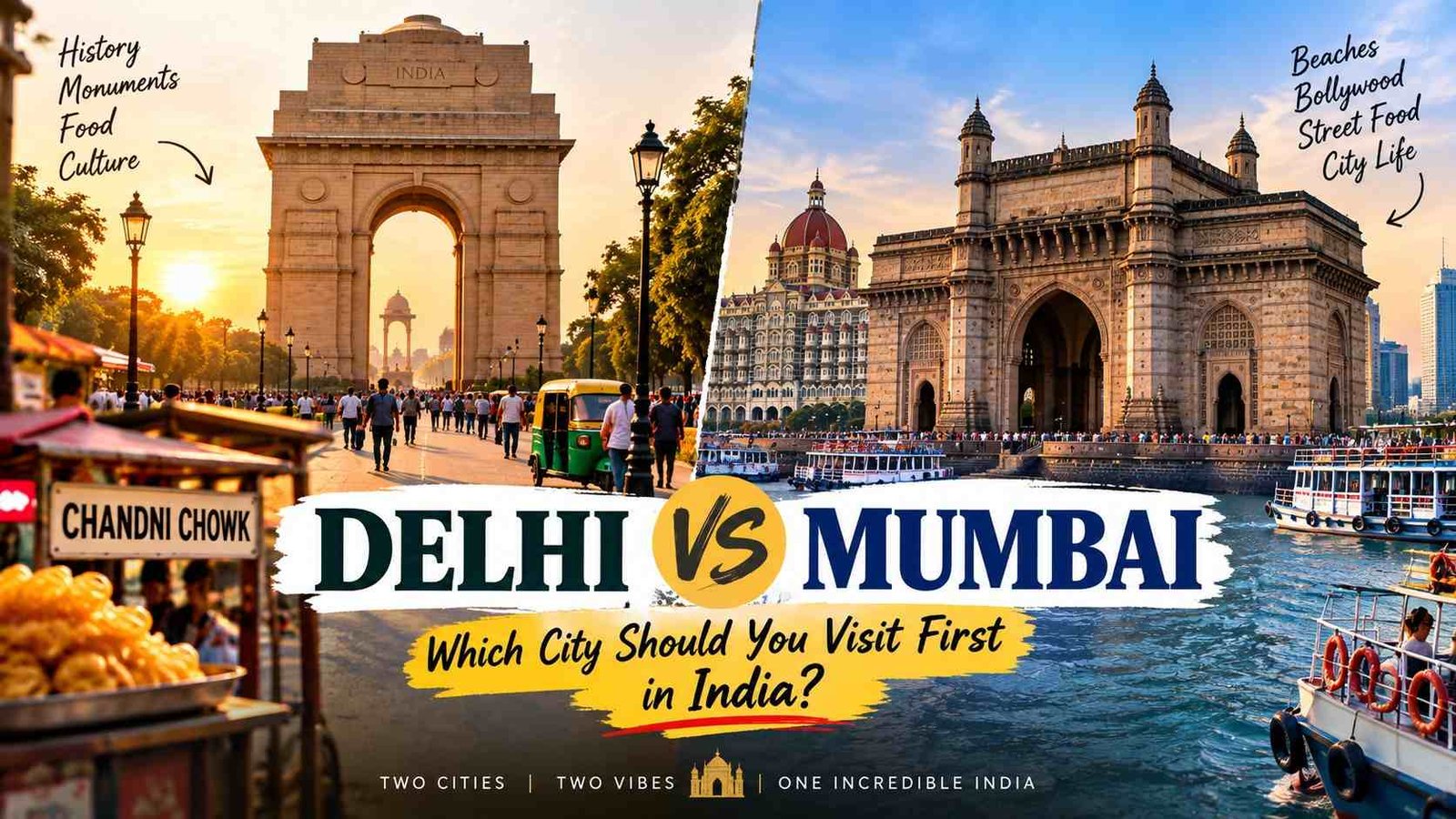
If you’re planning your first trip to India, Delhi vs Mumbai is one of the first decisions worth making.
Both cities are major international gateways, but the experience starts changing as soon as you leave the airport. Delhi puts you close to Mughal monuments, Old Delhi, Agra and Jaipur. Mumbai gives you a coastal city, colonial architecture, Bollywood, neighbourhood markets and a very different side of modern India.
So, Mumbai vs Delhi: which should you visit first?
For a first-time visitor planning the classic India route, Delhi usually makes more sense because you can combine the city with Agra and Jaipur without adding another flight. Mumbai makes more sense if your trip is centred around western India, Goa, coastal Maharashtra or a more urban itinerary.
Table of Contents
Here’s how I’d compare them.
Delhi vs Mumbai at a glance
| Delhi | Mumbai | |
|---|---|---|
| Best for | History, monuments, Golden Triangle | Coastal city life, food, modern India |
| First-time India trip | Excellent starting point | Good starting point |
| Taj Mahal access | Easy | Requires a longer journey |
| Agra access | Very convenient | Farther away |
| Jaipur access | Easy to combine | Usually requires more travel |
| Old-city experience | Old Delhi | South Mumbai and heritage districts |
| Street food | Chaat, kebabs, parathas, chole bhature | Vada pav, pav bhaji, bhel puri |
| Coast & sea views | Limited | Major attraction |
| Public transport | Delhi Metro | Local trains + Metro |
| Golden Triangle | Natural starting point | Requires extra travel |
| Best for a short India trip | Delhi | Mumbai if western India is the focus |
The choice becomes much easier once you decide what you want to see after the city.
Delhi vs Mumbai for a first trip to India
Start in Delhi if the Taj Mahal is high on your list
This is probably the biggest practical difference.
Delhi sits at the centre of the classic Delhi, Agra and Jaipur route. If you’re visiting India for the first time and want to see the Taj Mahal, Agra Fort and Jaipur’s forts and palaces, starting in Delhi keeps the route relatively simple.
You can spend time in Delhi, travel to Agra by road or train, continue to Jaipur and then fly onward.
That makes Delhi particularly useful when your trip is only 4 to 8 days long.
Taj Explorer’s Golden Triangle tours are built around this Delhi-Agra-Jaipur route, with private travel options for visitors who want to keep the itinerary flexible.
Mumbai requires a different plan. You can certainly visit Agra from Mumbai, but you’re adding a considerable amount of travel to an itinerary that could otherwise be spent exploring western India.
Choose Mumbai if you want India’s coastal side
Mumbai is a very different introduction to India.
The city sits on the Arabian Sea, and places such as Marine Drive, Colaba and the Gateway of India give your trip a strong coastal feel.
You can spend a morning around Colaba, visit the Gateway of India, walk through the Fort area and finish the day around Marine Drive.
Mumbai also gives you access to a different side of Indian food and culture. Vada pav, pav bhaji, bhel puri and seafood are part of everyday city life.
If Goa, coastal Maharashtra or western India is already on your itinerary, Mumbai fits naturally.
Mumbai vs Delhi: what will you actually see?
This is where the two cities start feeling very different.
Delhi: monuments, old markets and centuries of history
Delhi is the better fit if your idea of an India trip includes historic architecture.
You can visit the Red Fort in the morning, walk through parts of Old Delhi, see Jama Masjid, visit Humayun’s Tomb and finish the day around India Gate or Qutub Minar.
The distances between these places mean you’ll spend plenty of time travelling around the city, but that’s part of the Delhi experience.
Old Delhi is especially different from New Delhi.
The lanes around Chandni Chowk can be crowded, noisy and chaotic. Give yourself time to walk rather than trying to rush through the area for photographs.
For a more structured visit, Taj Explorer’s Old & New Delhi private guided city tour covers the two sides of the city in one day.
Mumbai: neighbourhoods, heritage buildings and the sea
Mumbai is easier to understand one neighbourhood at a time.
Colaba and Fort are good places to begin. You’ll find colonial-era buildings, cafés, galleries, markets and some of Mumbai’s most recognisable landmarks within the same part of the city.
Then there’s the waterfront.
The Gateway of India and Marine Drive give Mumbai something Delhi simply can’t replicate: a major Indian city where the sea is part of everyday life.
Mumbai also has Chhatrapati Shivaji Maharaj Terminus, Dharavi, Elephanta Caves and several neighbourhoods worth exploring beyond the usual tourist route.
If you enjoy walking, photography, architecture and observing everyday city life, Mumbai can keep you busy without needing a long list of monuments.
Delhi vs Mumbai for food
Food can easily influence the decision.
Delhi’s food culture is closely tied to North Indian and Mughal traditions. Old Delhi is known for parathas, kebabs, chaat, chole bhature and sweets such as jalebi.
Chandni Chowk is the obvious place to start, but don’t try to cover every food stop in one afternoon. Pick a few and leave enough time to walk around.
Mumbai has a different rhythm.
Vada pav is probably the food most closely associated with the city, while pav bhaji, bhel puri, sev puri, Bombay sandwiches and seafood give you plenty of other options.
The useful distinction is simple: Delhi is a strong choice if food history and North Indian cuisine interest you; Mumbai is a strong choice if you want street food with a coastal-city feel.
Delhi or Mumbai: which is easier for sightseeing?
Delhi Metro vs Mumbai Metro and local trains
Delhi is spread across a large area, but the Metro makes many tourist routes easier to manage.
You can use the Metro for parts of your sightseeing and combine it with taxis or private cars when an attraction isn’t convenient by train.
Mumbai’s local railway system is famous and extremely useful for residents, but first-time visitors need to be comfortable with crowded trains and busy stations.
Mumbai’s Metro network has also expanded, giving visitors more options for moving around the city.
For a holiday, though, your choice of neighbourhood matters almost as much as your choice of transport.
Staying closer to the places you want to visit can save hours.
Delhi vs Mumbai area: which city is bigger?
This question gets searched in slightly different ways, including Delhi vs Mumbai area and Delhi or Mumbai which is bigger.
The answer depends on what boundaries you’re comparing.
Delhi can refer to the National Capital Territory, while Mumbai may refer to the city itself or the wider Mumbai metropolitan region. Those are different geographical definitions, so comparing one number against another without defining the boundary can be misleading.
For a traveller, the more useful question is how the city feels to navigate.
Delhi is geographically spread out, with major attractions separated across different districts.
Mumbai is long and relatively narrow, with the Arabian Sea shaping the city’s geography.
That difference matters when you’re planning sightseeing.
Population of Delhi vs Mumbai
You’ll also find searches for population of Delhi vs Mumbai, but population figures depend on whether a source is referring to the city, municipal limits or the wider metropolitan area.
For visitors, population alone doesn’t tell you much about what a 3-day trip will feel like.
What you’ll notice is density.
Mumbai’s geography creates a very concentrated urban environment, while Delhi has much more variation between dense commercial areas, residential neighbourhoods, historic districts and large green spaces.
Delhi vs Mumbai for a short trip
If you’ve only got 2 or 3 days in India, I’d choose based on the rest of your itinerary.
A 3-day Delhi plan could look like this
Day 1: Old Delhi, Jama Masjid, Red Fort and Chandni Chowk
Day 2: Humayun’s Tomb, India Gate and Qutub Minar
Day 3: Agra day trip for the Taj Mahal and Agra Fort
That third day is where Delhi becomes particularly useful.
You don’t have to change hotels or take a domestic flight to see one of India’s most famous monuments.
A 3-day Mumbai plan could look like this
Day 1: Gateway of India, Colaba and Fort
Day 2: Marine Drive, heritage areas and local food
Day 3: Elephanta Caves or another neighbourhood-focused day
Mumbai works well when the city itself is the destination.
Delhi works particularly well when the city is the beginning of a wider North India itinerary.
Delhi vs Mumbai weather
Weather can make a bigger difference than people expect.
Delhi has much stronger seasonal changes.
Summer can be extremely hot, while winter brings cooler mornings and, at times, foggy conditions. The most comfortable sightseeing months are generally from October through March.
Mumbai stays warmer through the year, but humidity and the monsoon are important considerations.
The monsoon generally runs from June through September and can bring heavy rain.
For a first sightseeing trip, October to March is generally the easier period for both cities, although you’ll still want to check the forecast around your exact travel dates.
If you’re travelling during the hotter months, plan your sightseeing around the weather rather than trying to fit every attraction into the middle of the afternoon.
Delhi vs Mumbai for the Golden Triangle
This is probably the clearest deciding factor for international visitors.
The Golden Triangle of India connects Delhi, Agra and Jaipur.
Delhi is one point of the triangle, and Agra is only a practical road or rail journey away. Jaipur then continues naturally from Agra.
If your dream trip includes:
- Delhi’s historic monuments
- The Taj Mahal
- Agra Fort
- Jaipur’s forts and palaces
- Local markets and Indian food
then Delhi gives you a very practical starting point.
You can look at Taj Explorer’s Golden Triangle tour packages if you’d rather have the route arranged with private transport and local support.
Can you visit both Delhi and Mumbai on the same trip?
Yes, and for a longer India holiday, this can be a good way to see two very different sides of the country.
A 10 to 14-day itinerary gives you more room.
You could begin in Delhi, travel through Agra and Jaipur, then fly to Mumbai for several days before continuing to Goa or another western Indian destination.
That gives you two different city experiences rather than forcing yourself to decide between them.
For a shorter holiday, adding both cities can create unnecessary travel time.
Delhi or Mumbai which is better for your itinerary?
Instead of asking which city is universally better, look at what comes next.
Delhi fits your trip better if:
- The Taj Mahal is a priority.
- You want to visit Agra and Jaipur.
- You want a Golden Triangle tour.
- Historic monuments are a major reason you’re visiting India.
- You’re travelling to North India.
- You have only a few days.
Mumbai fits your trip better if:
- You want a coastal Indian city.
- Goa is part of your itinerary.
- Street food is a major interest.
- You enjoy neighbourhoods, architecture and urban photography.
- You want to explore western India.
- You’re interested in Bollywood and modern Indian city life.
And if you have enough time, you don’t necessarily have to choose.
What I’d recommend for a first-time India itinerary
For someone flying into India for the first time and asking us where to begin, we’d usually look at the whole route before choosing the airport.
If the trip includes the Taj Mahal, Agra and Jaipur, start with Delhi.
If the plan is Mumbai, Goa and western India, start with Mumbai.
If you have 10 or more days and want to see both sides of India, fly into one and continue to the other.
The city should fit the route, not the other way around.
A practical 7-day Delhi-based India trip
If you’re considering Delhi because you want to see the Taj Mahal, here’s one way to structure a week:
Day 1: Arrive in Delhi and settle into your hotel.
Day 2: Explore Old and New Delhi.
Day 3: Travel from Delhi to Agra and visit the Taj Mahal and Agra Fort.
Day 4: Travel from Agra to Jaipur.
Day 5: Explore Jaipur’s forts, palaces and old city.
Day 6: Continue exploring Jaipur or begin your return journey.
Day 7: Return to Delhi for your international flight.
You can shorten or extend this route depending on your flight schedule.
For travellers who want to make Agra the main focus, Taj Explorer also has a same-day Agra tour from Delhi for visitors who don’t want to stay overnight in Agra.
So, Delhi vs Mumbai: where should you go first?
For a first India trip, Delhi is the more practical starting point when the Taj Mahal and Golden Triangle are on your list.
Mumbai makes more sense when your trip is built around western India, coastal experiences, food and city life.
Neither choice gives you the whole of India. That’s the point.
Delhi introduces you to India’s historic north through monuments, markets and the road to Agra and Jaipur. Mumbai gives you a very different picture through its coastline, neighbourhoods, food and modern city culture.
So when you’re comparing Delhi vs Mumbai, start with your next destination.
If Agra and Jaipur are next, begin in Delhi.
If Goa and western India are next, Mumbai may fit your route more naturally.
And if you have enough time for both, see both. You’ll come away with a much broader picture of India than either city can provide alone.
Frequently asked questions
Is Delhi or Mumbai better for a first trip to India?
Delhi is usually the more practical starting point if your first India trip includes the Taj Mahal, Agra and Jaipur. Mumbai makes more sense when your itinerary focuses on western India and the coast.
Is Delhi or Mumbai bigger?
It depends on the geographical boundaries being compared. Delhi and Mumbai are measured differently across city, administrative and metropolitan definitions, so population or area figures should always be checked against the definition used.
Is the Taj Mahal closer to Delhi or Mumbai?
The Taj Mahal is much closer to Delhi. Agra can be reached from Delhi by road or train, making a day trip practical for many visitors.
Is Delhi or Mumbai better for food?
Both have strong food cultures. Delhi is particularly known for North Indian and Mughlai-influenced food, while Mumbai is famous for foods such as vada pav, pav bhaji, bhel puri and seafood.
How many days do I need in Delhi?
For the main sights, 2 to 3 full days works well. If you’re also using Delhi as the starting point for Agra and Jaipur, allow additional days for the wider itinerary.
How many days do I need in Mumbai?
Around 2 to 3 full days gives you time to explore central and southern Mumbai without rushing between neighbourhoods.
Can I visit Delhi, Agra, Jaipur and Mumbai in one trip?
Yes. With around 10 to 14 days, you have considerably more flexibility to combine the Golden Triangle with Mumbai. The exact route depends on your international and domestic flights.
Which is better, Delhi or Mumbai for the Golden Triangle?
Delhi is the natural starting point because the Golden Triangle connects Delhi, Agra and Jaipur. Mumbai isn’t part of the traditional Golden Triangle route.