

When you step into the courtyard of the Jama Masjid in Delhi, the roar of the city outside—the honking rickshaws, the shouting vendors, the sheer kinetic energy of India—suddenly fades into a hum. You are standing in a space designed nearly 400 years ago to “reflect the world,” and even today, it feels like the true center of it.
At Taj Explorer, we specialize in more than just sightseeing; we believe in immersion. In this comprehensive guide, we go deep into the history, architecture, and hidden secrets of the Jama Masjid. We also show you how to navigate the vibrant chaos of the surrounding streets like a seasoned local.
1. The History Behind Jama Masjid
To understand Jama Masjid, you need to understand the man who built it: Emperor Shah Jahan.
By the mid-1600s, the Mughal Empire was at its financial and artistic peak. Shah Jahan, the same emperor who built the Taj Mahal, decided to move his capital from Agra to a new city called Shahjahanabad. We know it today as Old Delhi.
The build itself was massive. Construction started in 1644 and took six years. Over 5,000 workers were involved, and it cost roughly one million rupees, a huge sum for the time. When it was inaugurated in 1656 by an Imam brought in from Uzbekistan, it wasn’t just a mosque. It was a statement.
Why the name? The official name is Masjid-i-Jahan-Numa, Persian for “Mosque that Reflects the World.” Most people call it Jama Masjid because of Jummah, the Friday congregational prayer it was built to host.
2. The Architecture: Red Sandstone and White Marble
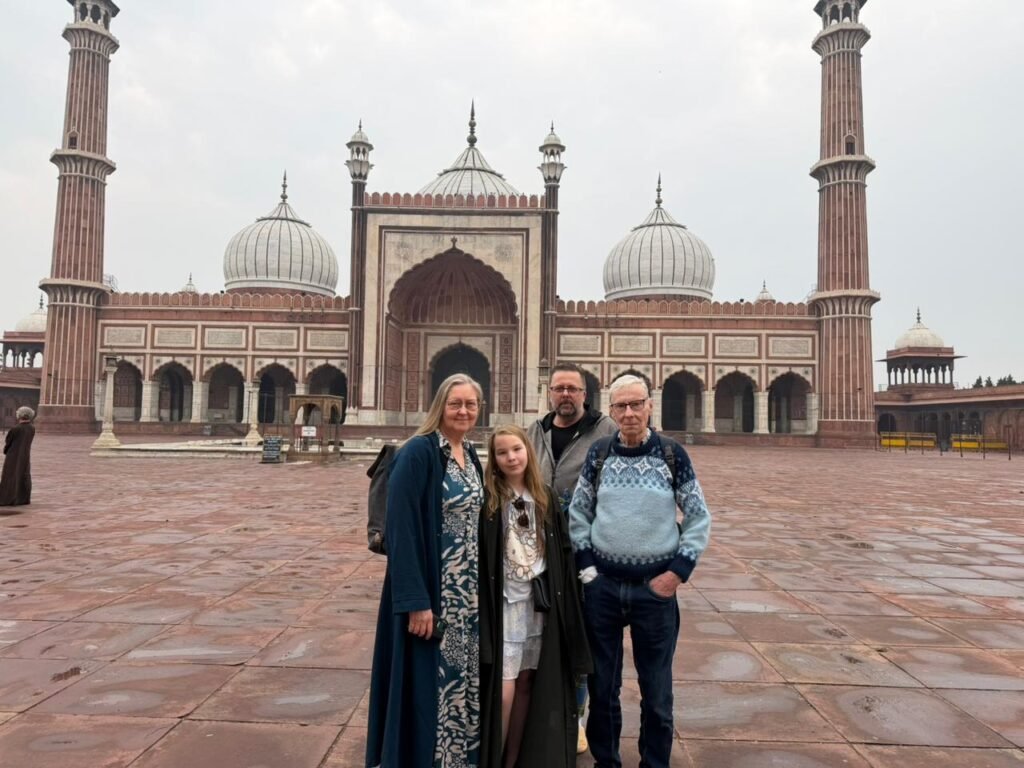
Mughal architecture runs on symmetry, and Jama Masjid is one of the finest examples of it.
The mosque is built mainly from red sandstone, which gives it that rugged, powerful look. White marble accents cut through it, adding a lighter, almost delicate contrast. That red and white combination became the signature style of the late Mughal period.
A few things to look for once you’re inside:
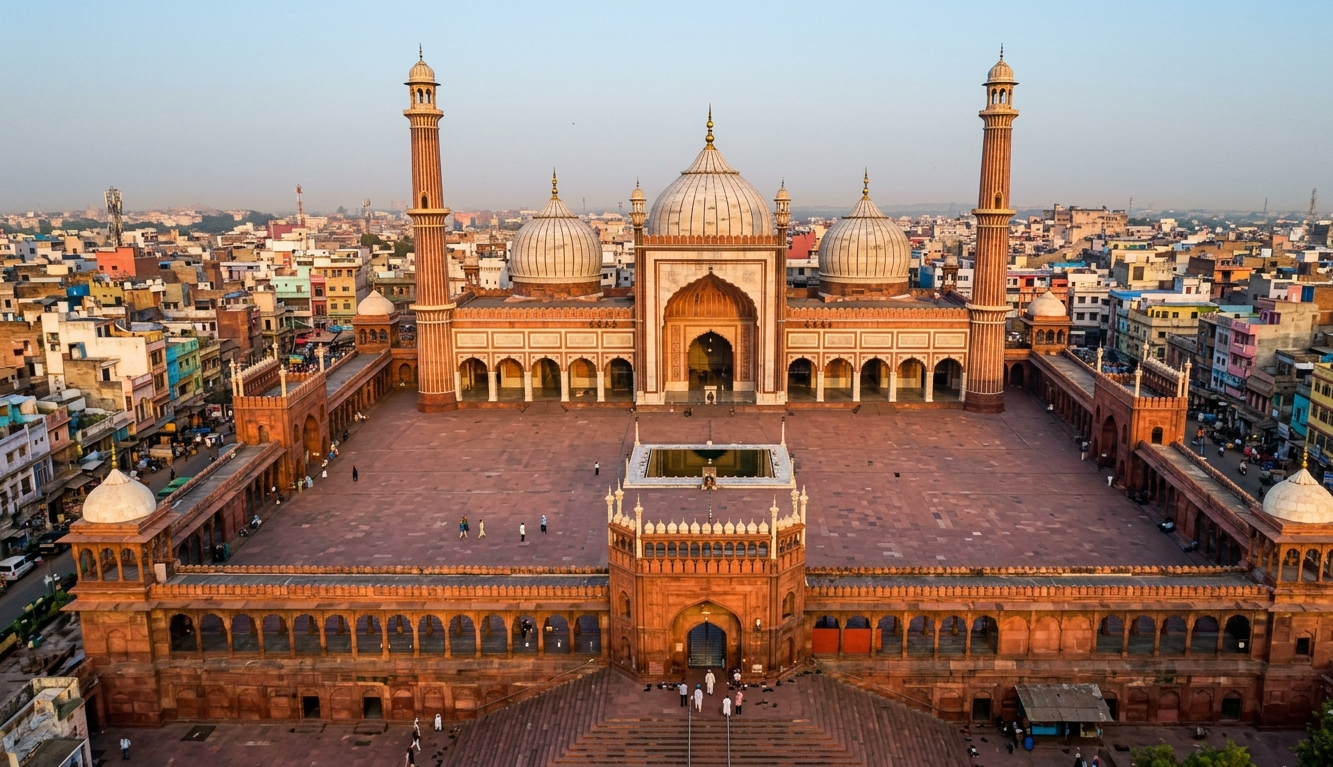
- The three domes. Striped in black and white marble, topped with gold spires (kalash). This is the skyline you see from across Old Delhi.
- The minarets. Two of them, standing 40 meters tall, balancing the scale of the courtyard below.
- The three gates. Gate 1 (south) is where most visitors enter. Gate 2 (east) was reserved for the Emperor. Gate 3 (north) is mostly used by locals coming from the surrounding markets.
3. The Courtyard: Room for 25,000 People
Nothing prepares you for the size of the courtyard until you’re standing in it.
It holds up to 25,000 worshippers at once. During Eid, the entire red sandstone floor disappears under prayer mats, one of the more striking sights you’ll see in Delhi.
In the center sits a marble ablution tank, used for Wudu before prayer. On a calm morning, the reflection of the domes in the water is worth a few extra minutes with your camera.
4. Climbing the Southern Minaret
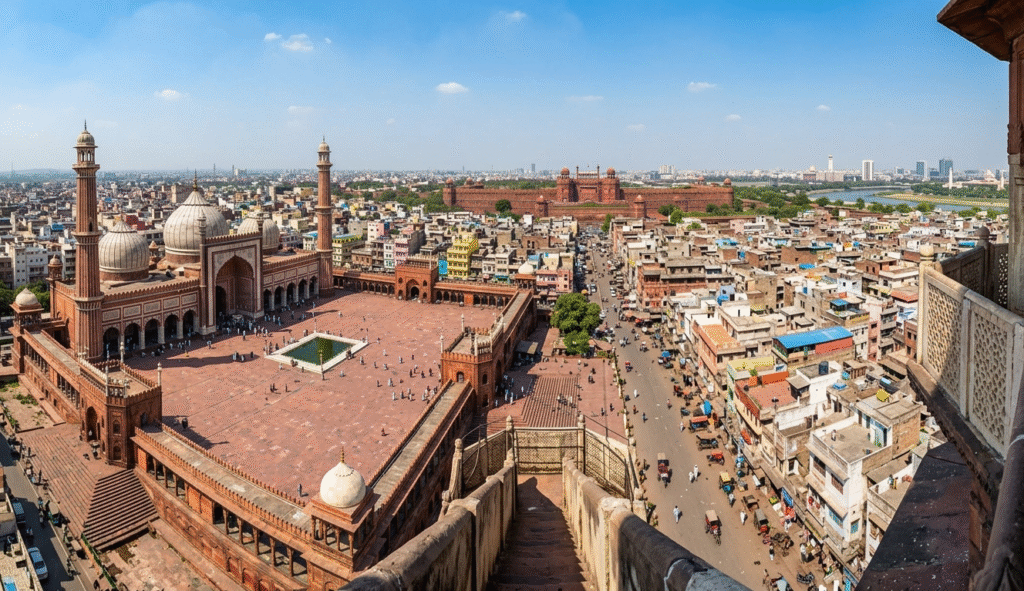
If you’re up for it, climb the Southern Minaret.
It’s a tight, winding staircase of 121 steps, and it can feel a bit close if you’re not used to narrow spaces. But the view from the top changes how you see the city. You can trace the straight line of Chandni Chowk toward the Red Fort, and on a clear day, spot the skyscrapers of New Delhi in the distance. Old and new Delhi, in one frame.
5. Matia Mahal: Where to Eat After Your Visit
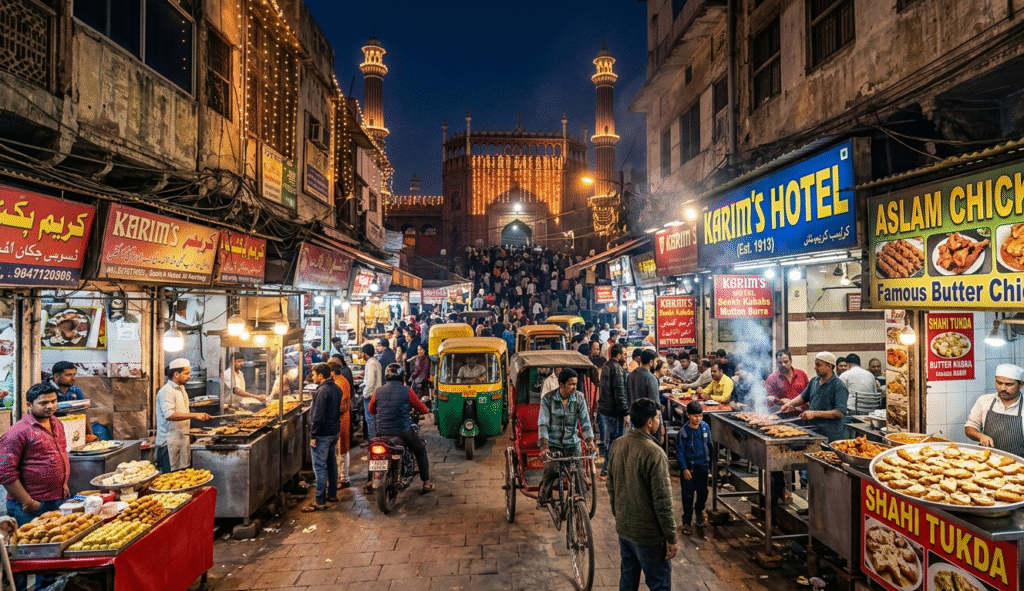
A visit to Jama Masjid isn’t really finished until you’ve walked through Matia Mahal, the neighborhood right at its base.
This is the food heart of Old Delhi, and we always send our guests here after the mosque.
- Karim’s, running since 1913, started by chefs from the royal Mughal kitchens. Order the mutton stew or the burra kababs.
- Aslam Chicken, known for butter chicken that comes swimming in melted butter and yogurt. Not for the diet-conscious, but worth it.
- Shahi Tukda, a street dessert of bread fried in ghee, soaked in syrup, and topped with thick rabri cream. Look for the vendors near the food lane.
6. Practical Tips for Visiting Jama Masjid
Best time for photos: 7:30 to 9:00 AM, when the light is softest and the crowds haven’t built up yet.
Best time for atmosphere: Late afternoon, as the sun drops and the Azaan (call to prayer) echoes across the courtyard.
Shoes: You’ll remove them at the entrance. Attendants keep an eye on them for a small tip, usually 10 to 20 rupees.
Dress code: Modest clothing is required, shoulders and knees covered. We carry spare wraps for our guests, and the mosque also rents robes at the gate if you need one.
7. Jama Masjid FAQs
Is there an entry fee for Jama Masjid?
No. Entry is free. If you want to bring a camera or take photos on your phone, there’s a photography fee of around 300 rupees.
Can non-Muslims visit the mosque?
Yes, visitors of all faiths are welcome. The only request is to stay out of the main prayer hall during active prayer times.
What’s the best way to reach Jama Masjid?
The Delhi Metro is the easiest option. Get off at the Jama Masjid station on the Violet Line, then it’s a short walk or a quick rickshaw ride to Gate 1.
Is the climb up the minaret safe?
The stairs are steep and narrow, so it’s fine for most people with average fitness. We wouldn’t recommend it if you deal with claustrophobia, have a heart condition, or have trouble with mobility.
What should I wear?
Both men and women should cover their shoulders and knees. If you’re in shorts or a sleeveless top, you’ll be asked to wear a rental robe at the entrance.
Are there relics inside the mosque?
Yes. The mosque holds a small collection, including a Quran written on deerskin and what’s said to be a footprint relic of the Prophet Muhammad. These are usually on display at specific times, so it’s worth asking at the entrance.
8. Why Visit with a Guide
Old Delhi is a maze, and for a first-time visitor, the noise and crowd can be a lot to take in on your own.
A guide handles the parts that usually trip people up: navigating the lanes, managing entrance logistics and shoe-keeping, and knowing which stories about the building aren’t written on any sign. That leaves you free to actually take the place in instead of worrying about getting lost.
9. Pairing Your Visit: A Simple Old Delhi Itinerary
We usually pair Jama Masjid with:
- Red Fort, about a 10-minute rickshaw ride away.
- Khari Baoli, the world’s largest wholesale spice market, a short walk from the mosque.
- Raj Ghat, the memorial to Mahatma Gandhi, a quieter stop to end the day.
A Final Word
Jama Masjid holds the past and the present in the same courtyard. It’s grand in scale but still feels personal once you’re standing inside it.
If you’re planning a trip to Old Delhi, this is one stop worth building your morning around. Book a Jama Masjid and Half Day Delhi tour with Taj Explorer, and we’ll handle the logistics while you take in the rest.